

The Evolution of Socio-Cultural and Digital Segmentation in Marketing: A Miami Case Study
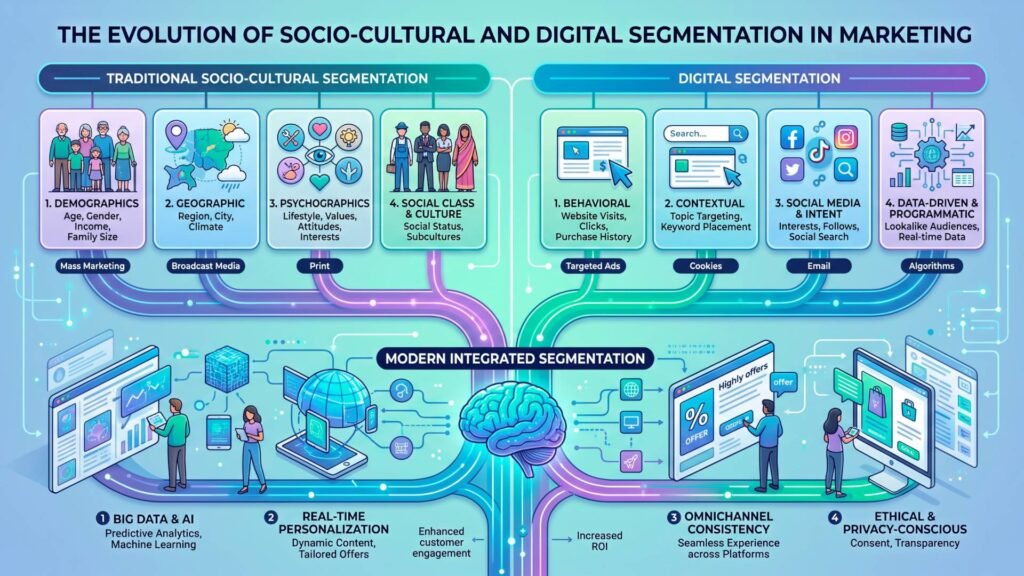
A strategic look at how audience segmentation has moved beyond ABC1/C2/C3 models, and what that means for a market as diverse as Miami.
Executive Summary
For decades, marketing organized audiences around fairly simple socioeconomic variables – the classic ABC1, C2, C3, D, and E tiers – built for a world of mass, one-directional media. That world doesn’t exist anymore. Today’s audiences move between platforms, formats, and digital communities that demand a much sharper read on who someone is, what they consume, and why.
This piece proposes an updated segmentation model, one that layers in socio-cultural variables and digital behavior, and applies it to a particularly complex and diverse market: Miami. The core takeaway is that the platform someone uses most — and the type of content they engage with there has become one of the clearest indicators of their socio-cultural profile, right alongside education level and occupation.
1. Introduction
Audience segmentation has changed more in the last ten years than in the previous forty. Traditional models, built on socioeconomic categories like ABC1, C2, C3, D, and E useful in their time for planning media buys across TV, radio, and print have lost much of their predictive power in a digital ecosystem that demands precision, cultural context, and an understanding of platform behavior.
This report has three concrete goals:
- Trace the historical evolution of audience segmentation and explain why the ABC model stopped being sufficient.
- Describe a socio-cultural and digital approach that integrates education, occupation, cultural capital, and platform behavior.
- Apply that approach to a specific, highly diverse case: the Miami market.
2. From ABC1 to Multidimensional Models
2.1 Traditional Segmentation
Between the 1980s and the early 2000s, segmenting an audience meant, in practice, classifying households by asset ownership (car, television, washing machine), housing type, access to basic services, and household income. It was a reasonable model for its time: media was mass, one-directional, and relatively uniform within any given time slot or publication.
2.2 Why That Model No Longer Holds Up
The problem isn’t that the ABC model is “wrong” it’s that it was designed for an environment marketers no longer operate in. That model doesn’t reflect digital habits, doesn’t capture meaningful cultural differences within a single income bracket, doesn’t account for specific consumption behaviors, and, most importantly, offers no useful guidance for planning on platforms like TikTok, Meta, Google, or YouTube, which run on entirely different segmentation logic.
3. Modern Segmentation: Socio-Cultural Meets Digital
The model proposed here rests on five variables. None of them work well in isolation it’s the combination that produces a reliable read on an audience.
| Variable | What it captures |
|---|---|
| 1. Per-capita income | Still a useful reference point, but no longer sufficient on its own two people with similar income can have very different consumption behaviors. |
| 2. Education level | The most consistent predictor we found. It correlates directly with the type of content someone consumes, the platform they prefer, and the communication style that resonates with them. |
| 3. Occupation | Defines aspirations, lifestyle, and real purchasing power, beyond nominal income. |
| 4. Cultural capital | Interests, values, aesthetics, and symbolic consumption what gives someone status or identity, beyond what they can afford. |
| 5. Digital behavior | In 2026, the most decisive variable: primary platform, frequency of use, type of content consumed, and level of engagement. |
4. Platforms as Socio-Cultural Markers
One idea that tends to hold up in practice: digital platforms now function as socio-cultural markers. They don’t determine who someone is, but they do correlate consistently with educational background, occupation, and interests. This doesn’t mean a platform “belongs” to a segment, anyone can use any network, but at an aggregate level, clear usage trends do emerge:
| Platform | General usage trend |
|---|---|
| TikTok | Relatively higher penetration among segments with lower average schooling or less formal cultural capital. |
| Strong aspirational component: fashion, aesthetics, fitness, and lifestyle. | |
| YouTube | Cuts across nearly every segment; blends education, tutorials, and entertainment. |
| Concentrated among professional profiles, executives, and higher education levels. | |
| Strong among older segments, local communities, and family networks. |
This lines up with recent studies that treat digitalization as another dimension of socioeconomic segmentation, rather than as a separate data point.
5. Applying This to the Miami Market
Miami is arguably one of the hardest markets to segment with classic models: it’s deeply multicultural, shaped by multiple waves of immigration, and features very tight coexistence between different socioeconomic levels within a single metro area. Applying ABC1/C2/C3 to Miami would mean ignoring exactly what makes this market distinct. Instead, we propose three directional segments, built around schooling, digital behavior, and area of residence, not national origin, which is far too heterogeneous within each segment to be used deterministically.
Segment A — Higher Education, Professional Profile
- Leading platforms: Instagram, LinkedIn, YouTube
- Content affinity: Luxury, wellness, business, investment, and real estate
- Representative areas: Brickell, Coral Gables, Miami Beach
- A profile common among professionals and executives with high international mobility, though not exclusive to them — other profiles are present in the same areas too.
Segment B — Middle Class, Mid-Level Education
- Leading platforms: Facebook, Instagram, YouTube
- Content affinity: Family, local community, deals, and everyday services
- Representative areas: Kendall, Hialeah, Homestead
- A broad, heterogeneous segment with strong community and neighborhood identity.
Segment C — Lower Schooling, Tighter Income
- Leading platforms: TikTok, Facebook
- Content affinity: Humor, music, entertainment, and viral trends
- Representative areas: North Miami, Opa-Locka, parts of Hialeah
- Includes both long-time residents and more recently arrived immigrant communities, the common thread is the digital consumption pattern, not the origin.
6. Then vs. Now: A Direct Comparison
| Dimension | Previous model | Current model |
|---|---|---|
| Classification basis | Household assets and services | Education, occupation, culture, and digital behavior |
| Reference media | TV, radio, print | TikTok, Meta, Google, YouTube |
| Precision | Low and aggregated | High and granular |
| Cultural factor | Practically absent | Central to the analysis |
| User behavior | Not considered | A core variable |
7. Conclusions and Recommendations
ABC1, C2, and C3 segments no longer accurately describe how people consume, inform themselves, and make decisions. Modern segmentation needs to lean on cultural capital, education level, occupation, and digital behavior to be genuinely useful when planning campaigns and prioritizing platforms.
For a market like Miami, that translates into some concrete recommendations:
- Design differentiated platform strategies by segment, rather than generic spend spread evenly across every network.
- Prioritize education level and observed digital behavior as targeting variables, ahead of nominal income.
- Avoid mechanically linking national origin or immigrant community with socioeconomic level, every community contains very different profiles, and treating them as a homogeneous bloc reduces the model’s precision.
- Revisit and update segments regularly, digital behavior shifts faster than classic demographic variables do.
In short: the platform someone uses, and how they use it, now says as much about their profile as the neighborhood they lived in or the appliances in their home once did. That’s the underlying shift this report set out to make visible.
Strategic segmentation report – July 2026. The patterns described reflect general trends observed across the digital ecosystem and should not be read as absolute rules or as fixed characterizations of any group or community.
