

The End of the Infinite Content – Core Relevance
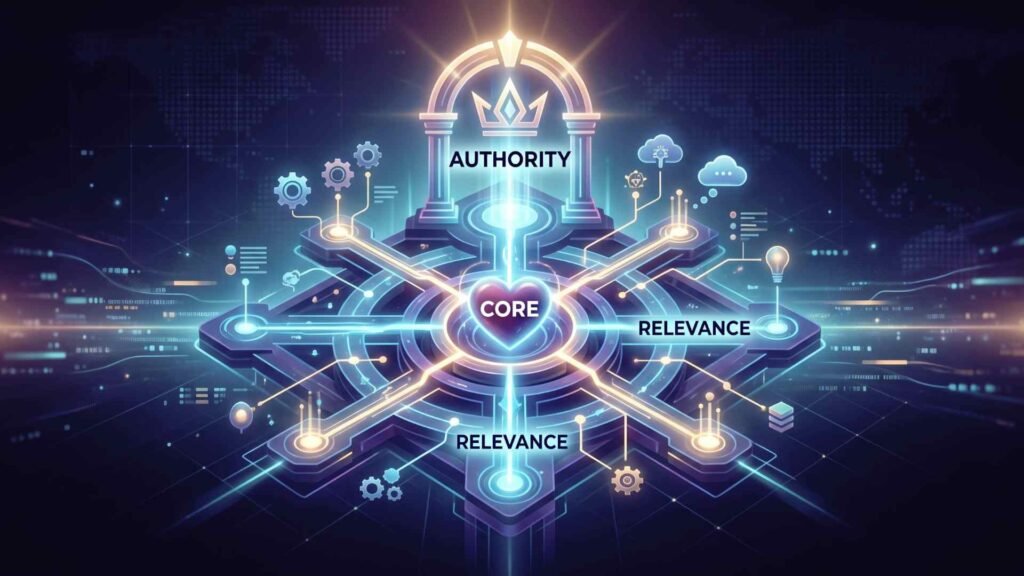
Why Domain Authority is Your Only Lifeline in the Age of Bots
The internet landscape has shifted dramatically. If you manage a website or lead an SEO strategy, you’ve undoubtedly noticed: the web is flooded. The democratization of generative AI has removed the barrier to entry for content creation. Today, any bot or automated script can churn out thousands of articles in minutes—with little to no human oversight.
The result? An ocean of flat, homogeneous text, mostly devoid of real-world experience.
Faced with this massive plagiarism of ideas and the saturation of the SERPs (Search Engine Results Pages), engines like Google have been forced to make drastic moves. It’s no longer enough to publish an optimized 2,000-word article. If the algorithm cannot trust who is saying it and where it is being said, that content simply does not exist.
In today’s SEO landscape, the game is no longer won by producing more, but by proving authority.
Google’s Filter Against the Machines: E-E-A-T and Trust
When anyone can publish content at scale, Google needs a tie-breaker that machines cannot easily fake. That criteria is summed up in the acronym E-E-A-T (Experience, Expertise, Authoritativeness, and Trustworthiness).
Algorithms are meticulously designed to look for unmistakable signals that a website is a legitimate, respected entity validated by other players in the industry. Pages created by bots on domains with no history or reputation plummet with every major Google Core Update.
Why? Because they lack the backbone of high-trust SEO: quality external references.
Relevant Backlinks: The Vote of Confidence Bots Can’t Forge
In this crowded ecosystem, inbound links—or backlinks—have regained absolute prominence, but with a crucial twist: quality and hyper-relevance are everything.
Years ago, volume-based SEO worked; you could buy hundreds of links from generic blog farms and watch your rankings climb. Today, doing that is digital suicide. Google detects artificial patterns in seconds.
The only authority that moves the needle is the one transferred from websites that share a logical, semantic connection with your industry. If you sell web development services, a link from a cooking blog does nothing for you, no matter how much authority that cooking site has. You need the tech industry to validate your relevance.
A relevant backlink acts as a real-world digital testimonial: it tells search engines that a trusted site is backing your content. It is a human, editorial signal that pure automation cannot replicate.
Building Real Authority with CoreRelevance
Understanding the theory is easy, but executing a link-building strategy that meets modern relevance standards is where most businesses fail. It’s not about “getting links”; it’s about weaving a network of mentions that make semantic and strategic sense.
At CoreRelevance.net, we were born precisely to solve this challenge in the post-AI era. We don’t believe in mass link packages or automated blog networks that dilute your brand.
- Strict Semantic Filtering: We connect your website exclusively with media and portals that share your thematic context, ensuring every drop of transferred authority is interpreted positively by search algorithms.
- Human Curation Against the Noise: In an ecosystem plagued by machine-made content, we guarantee that the platforms housing your links maintain a real standard of quality, featuring genuine organic traffic and brand authority.
- Long-Term Security: We design natural link profiles that withstand algorithmic updates, protecting your investment and establishing your business as a benchmark in your niche.
Automation has rewritten the rules of online visibility. When content is infinite, authority becomes the scarcest and most valuable resource. Don’t let your website drown in bot noise; give search engines the ultimate reason to trust you.
By Lucas B. – June 6, 2026
Visit us at CoreRelevance.net and submit your webnsite now!
